
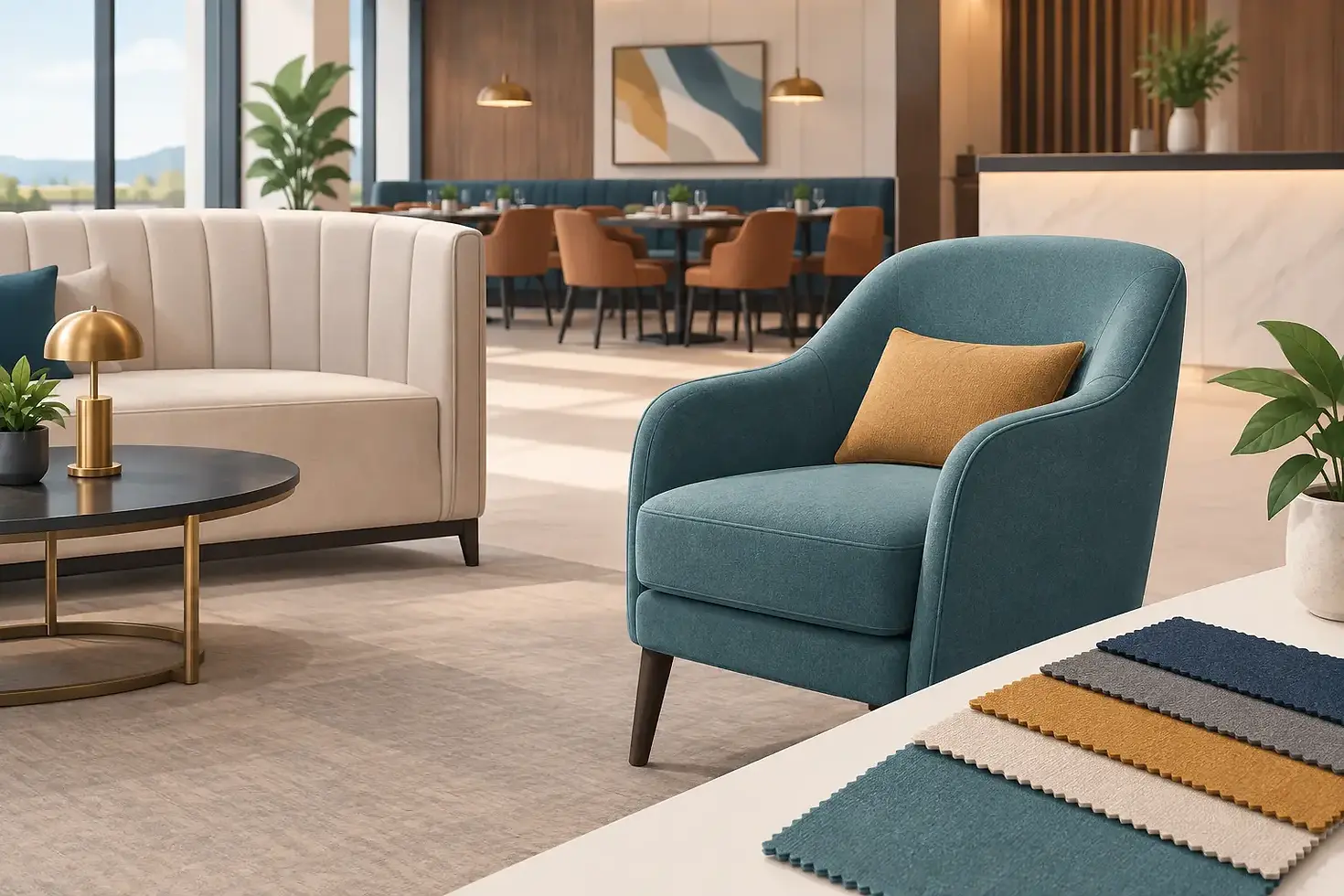
Contract Upholstery for Hospitality Projects
A guest may never see the engineering inside a lounge chair, banquette, or upholstered bed, but they will experience its result immediately. Contract upholstery must look considered on opening day, feel comfortable through repeated use, and retain its shape, finish, and visual standard over time. For hospitality designers, procurement teams, and developers, that makes upholstery a specification and production decision, not simply a fabric selection.
The strongest results come from treating the upholstered piece as a complete system. Frame construction, suspension, foam, fiber, fabric, tailoring, cleaning requirements, and freight protection all influence performance. When these elements are coordinated early, custom seating can preserve design intent while meeting the practical demands of guestrooms, lobbies, restaurants, suites, and shared amenity areas.
What Defines Contract Upholstery
Contract upholstery is built for commercial use, where appearance, durability, safety, and repeatability matter at the same time. It applies to upholstered furniture in environments with sustained occupancy and higher cleaning demands, including hotels, resorts, restaurants, corporate spaces, multifamily common areas, and healthcare-adjacent hospitality settings.
Residential-grade materials can be appropriate for low-use decorative applications, but they are not automatically suitable for a hotel lobby or guestroom program. A hospitality piece may need to withstand luggage impacts, frequent sitting, housekeeping procedures, food and beverage exposure, and ongoing movement during room turns or event setups. The correct construction depends on the use case, not solely on how refined the finished piece appears.
A custom manufacturer should review the project holistically. A low-profile sofa with a highly tailored silhouette, for example, may require a different foam strategy and suspension system than a deep lounge chair intended for extended seating. Likewise, a channel-tufted headboard calls for different fabric handling and pattern alignment than a smooth upholstered wall panel.
Start With the Intended Use
The first specification question should be straightforward: how will this piece actually be used? A guestroom bench, a cocktail lounge banquette, and a conference room chair can all use premium upholstery, yet each faces a distinct combination of traffic, cleaning, comfort, and visual expectations.
High-traffic public areas generally benefit from materials and construction that prioritize recovery and serviceability. Seat cushions must maintain their profile through frequent use. Fabrics need an appropriate level of abrasion resistance without feeling overly technical or compromising the designer's palette. Details such as contrast welts, exposed stitching, button tufting, and tight radii should be evaluated carefully because they add character while introducing additional labor and potential wear points.
Guestroom upholstery often requires a different balance. Comfort remains essential, but the design may place greater emphasis on a residential feel, softer hand, and a tailored presentation that supports the room concept. In this setting, the manufacturer must still account for housekeeping, luggage contact, and the consistency required across hundreds of rooms.
Build the Specification From the Inside Out
A well-specified upholstered product begins beneath the cover. The internal materials determine how a piece sits, wears, and recovers long after the initial installation.
Frame and Suspension
The frame establishes the foundation for dimensional stability and long-term performance. Species, joinery, rail thickness, blocking, and reinforcement should align with the furniture's scale and intended loading. Larger sectionals, long banquettes, and units designed for public seating require particular attention to frame support and connection details.
Suspension affects both comfort and durability. Depending on the design, sinuous springs, webbing, spring units, or a combination of support methods may be appropriate. There is no single best solution for every project. The right choice depends on seat depth, cushion construction, desired sit, furniture profile, and expected frequency of use.
Foam, Fiber, and Cushion Construction
Foam selection should be based on the intended feel and performance level rather than density alone. A lounge chair may need supportive comfort with a controlled, tailored profile, while a sofa may call for a softer sit without premature flattening. Fiber wraps and blend-down constructions can improve the hand and appearance of cushions, but they also affect maintenance expectations and the degree of fluffing or rotation a property may require.
For fixed upholstery, the challenge is different. Tight seats and backs must retain clean lines without becoming uncomfortably firm. The manufacturer should review the upholstery thickness, foam contours, seam placement, and panel proportions together. These decisions are especially important where the design includes curved forms, deep channels, or precise upholstery breaks.
Cover Materials and Tailoring
Fabric, leather, vinyl, and performance textiles each offer distinct advantages. The best choice depends on the location, aesthetic direction, maintenance protocol, and budget. A natural woven textile may bring warmth and depth to a guestroom, while a high-performance textile may be better suited to a busy restaurant banquette. Leather can age beautifully in selective applications, but it requires careful review of hide yield, color variation, and cleaning procedures.
Patterned materials require early coordination. Repeat size, directionality, fabric width, and railroaded application can significantly affect yardage, cutting plans, and seam locations. The same is true for leather, where natural markings and hide dimensions influence panel layouts. These are not details to resolve after production begins.
Performance Requirements Need Context
Testing standards and performance ratings are useful, but they do not replace project-specific judgment. Abrasion resistance, colorfastness, pilling, flammability, stain resistance, and cleanability should be evaluated in relation to the actual installation. A material that performs well in a private office may not be the right choice for a high-volume hotel lounge.
Flammability requirements should be confirmed at the project level, with attention to applicable jurisdiction, occupancy type, and the furniture's final location. Requirements can vary, and the entire upholstery assembly may need consideration, not merely the face fabric. Early documentation reduces the risk of late substitutions that alter color, texture, lead time, or cost.
Cleaning is equally important. Hospitality operations need practical guidance they can follow. If a selected textile requires specialized care, that limitation should be understood before installation. A beautiful cover material that cannot tolerate the property's routine cleaning approach can become a costly operational issue.
Translate Design Intent Into Production Detail
The difference between a compelling rendering and a successful installed piece often comes down to production coordination. Upholstered furniture needs clear dimensions, elevations, section details, fabric assignments, finish references, and construction notes. For custom work, shop drawings are the point where visual intent becomes buildable information.
Designers may specify a tight radius, a floating base, a particular cushion break, or a slim upholstered arm. Each can be achieved, but each also affects internal construction, fabric tension, comfort, and durability. A capable manufacturing partner explains those implications early and proposes solutions that protect the design rather than simplifying it without discussion.
Mockups, strike-offs, and sample approvals are particularly valuable when a project includes complex tailoring or a large quantity of repeated units. They allow the project team to confirm comfort, proportion, stitch details, welt scale, and material appearance under real conditions. For branded hospitality environments, this review also helps maintain consistency from one room type or property to another.
Plan for Scale, Lead Times, and Installation
Custom contract upholstery requires coordination across material procurement, cutting, sewing, frame production, finishing, upholstery, quality control, packaging, and delivery. The production plan should account for customer-supplied materials, especially when fabrics have limited availability, variable lead times, or strict dye-lot requirements.
Scalability matters when the program expands from a prototype room to a full property rollout. The manufacturer must be able to maintain approved specifications, workmanship standards, and visual consistency across production batches. At Luxedge Furniture, that coordination extends from shop drawings and production planning through finished-product delivery, with North American and overseas manufacturing options selected according to project requirements.
Packaging deserves similar attention. Upholstered surfaces are vulnerable to abrasion, compression, moisture, and dust during transit and installation. Protective methods should suit the item, whether it is a loose-cushion sectional, an upholstered headboard, or a long custom banquette requiring staged delivery.
Choose a Partner That Can Resolve Details Early
The best upholstery partner does more than quote dimensions and yardage. They ask where the piece will be installed, how it will be used, which details are non-negotiable, and what performance requirements the property must meet. They also identify the trade-offs clearly. A very soft seat may need more maintenance. A delicate textile may be better reserved for a protected location. An intricate tailored detail may require additional lead time and careful handling.
That level of coordination gives design and procurement teams better control over cost, schedule, performance, and final appearance. When contract upholstery is developed with the same discipline as case goods and architectural millwork, it becomes a lasting part of the guest experience rather than a finish decision left to chance.


Comments